Quick answer
Puri's Rath Yatra takes Lord Jagannath, Balabhadra and Subhadra on three giant wooden chariots along the 3 km Grand Road to the Gundicha Temple, usually in late June or early July. The return journey, Bahuda Yatra, follows about nine days later. Book Puri hotels two to three months ahead, rent a balcony seat on Grand Road and stay out of the crush near the chariots.
Highlights
- Three new chariots, built every year, hauled by lakhs of devotees
- Pahandi, the swaying procession of the deities to the chariots
- Chhera Pahanra, when the Gajapati king sweeps the chariots
- The one chance for non-Hindus to see Lord Jagannath
- Bahuda Yatra and Suna Besha, the golden attire, on the return
What actually happens
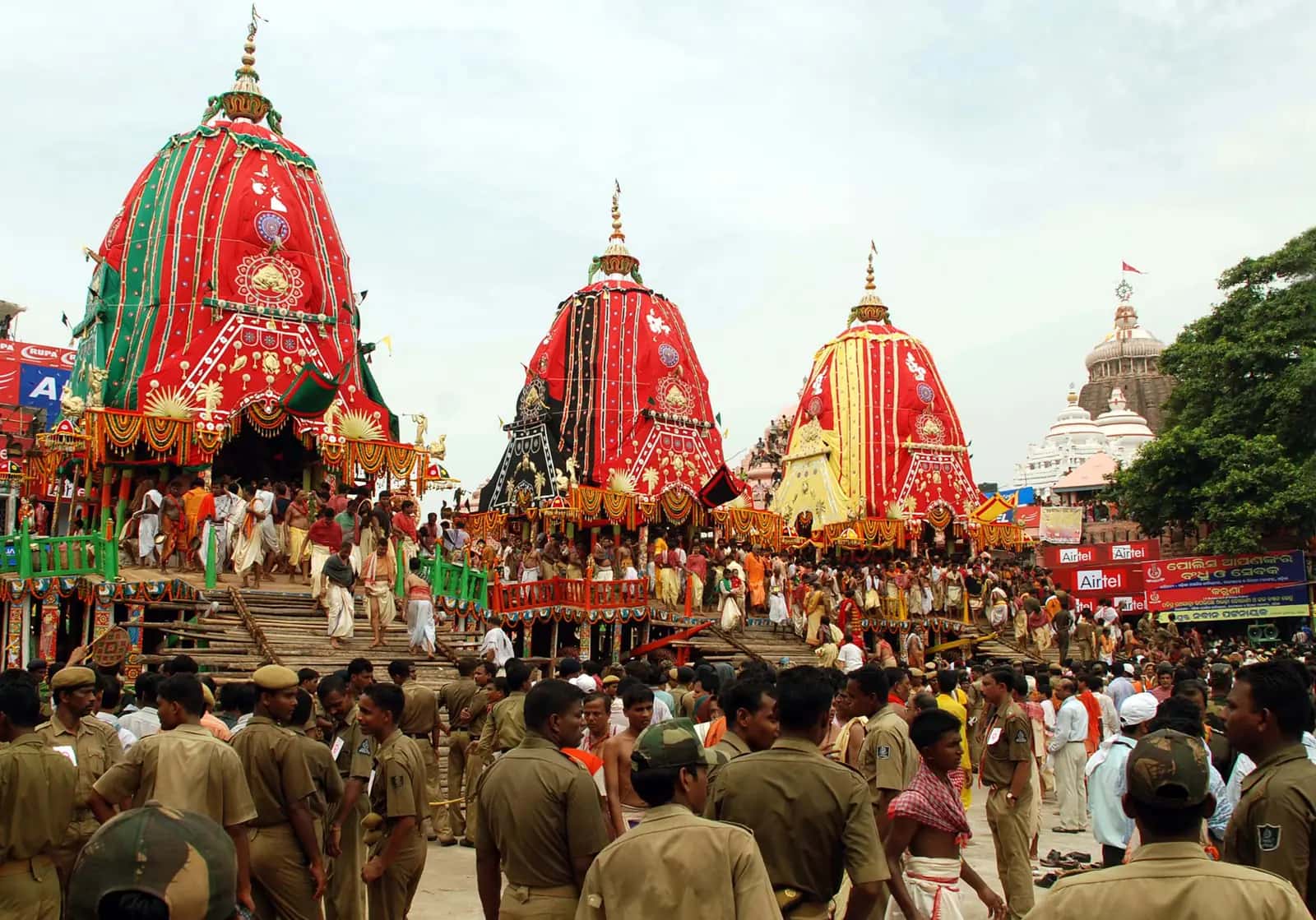
Every year, Lord Jagannath, his brother Balabhadra and sister Subhadra leave the Jagannath Temple in Puri for a nine-day stay at the Gundicha Temple, about 3 km up Bada Danda, the Grand Road. They travel on three new wooden chariots built each year by hereditary carpenters: Nandighosa for Jagannath with 16 wheels, Taladhwaja for Balabhadra with 14, and Darpadalana for Subhadra with 12.
On the day, the deities are carried out to the chariots in a swaying procession called pahandi. The Gajapati king of Puri then sweeps the chariot platforms with a gold-handled broom, the Chhera Pahanra ritual, and in the afternoon lakhs of devotees haul the chariots with thick ropes. The journey can take one day or stretch into two. About nine days later, the Bahuda Yatra brings the deities back, followed by Suna Besha, when they are dressed in gold on their chariots.
For visitors there is another reason it matters: non-Hindus are not allowed inside the Jagannath Temple, and this is the one time anyone can see the deities.
Best days to go
The Rath Yatra falls on the second day of the bright half of Ashadha, usually in late June or early July. The Bahuda Yatra and Suna Besha make a good second visit.
Where to stay and how to watch
Puri hotels that charge ₹2,000–4,000 normally ask ₹5,000–15,000 on Rath Yatra nights, often with minimum stays. Book two to three months ahead; Bhubaneswar, 60 km away, is the fallback. The best way to watch is from a balcony or rooftop on Grand Road, which hotels and homeowners rent for about ₹2,000–10,000 per person at the time of review.
Crowds, heat and safety
Crowds run to several lakh, it is 32–34°C and humid with monsoon showers, and fatal crushes have occurred in recent years. Do not join the rope-pulling crowd with children or older parents, carry water and oral rehydration salts, and agree a meeting point in case you get separated.
Photography and what to wear
From a balcony, a zoom lens or a phone with good zoom works best. Drones are banned over the route. Wear light cotton and slip-on sandals, and keep valuables in a zipped pouch.
Combining it
Konark's Sun Temple is 35 km away, Bhubaneswar's temples about an hour, and Chilika Lake about two hours. See the best time to visit Odisha, things to do in Odisha, our July ideas and the festival calendar.
Frequently asked questions
When is the Puri Rath Yatra?
Can non-Hindus attend the Puri Rath Yatra?
What is the best way to watch the Rath Yatra?
Is the Rath Yatra safe for children and older travellers?
How we checked this page
Last reviewed
Written and fact-checked by the Elitech Travels editorial desk in New Delhi, drawing on our consultants' day-to-day booking work and the official sources below. Rules, fares and fees change — always confirm anything critical with the issuing authority before you travel. Our editorial policy.